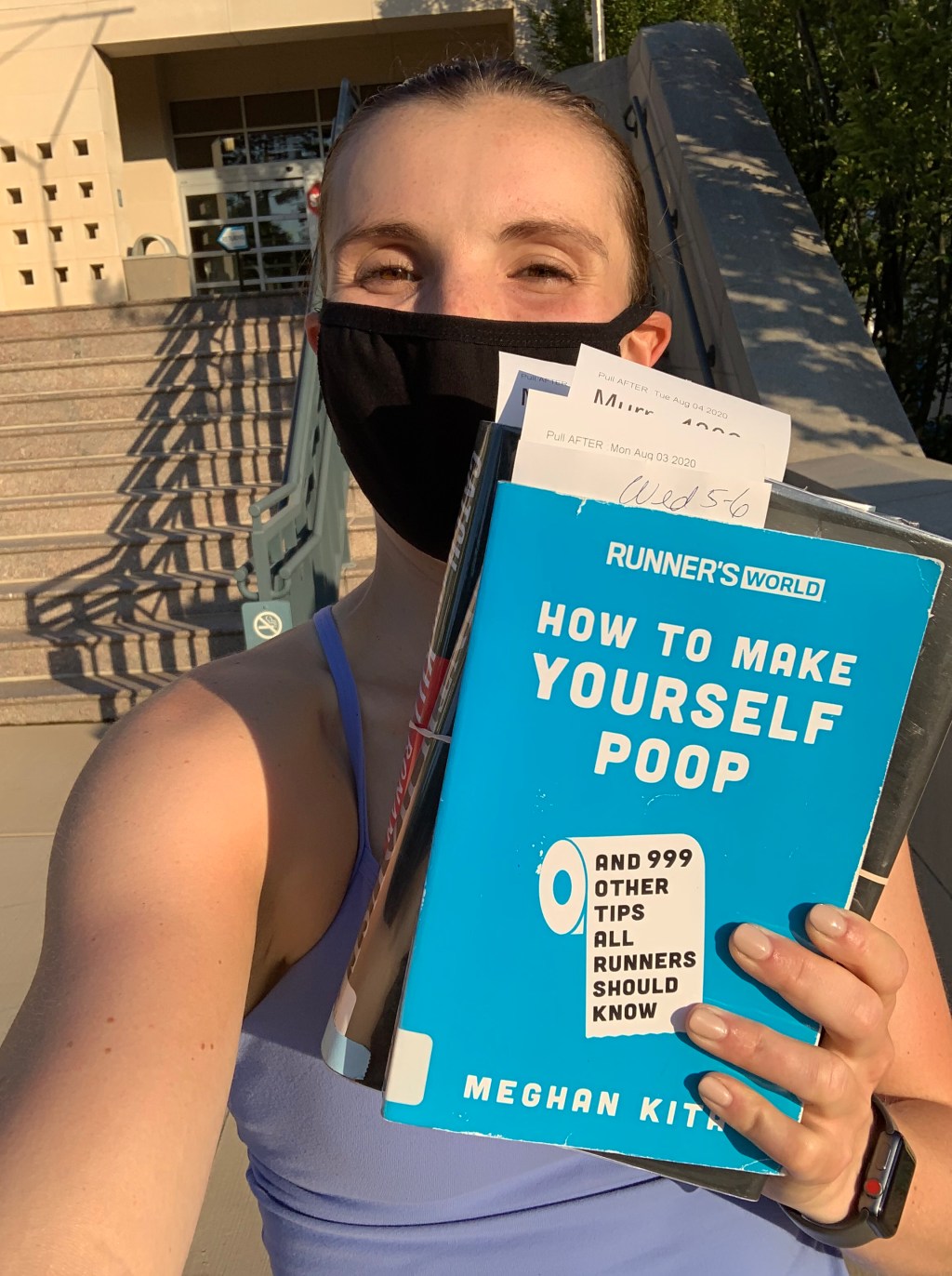

I. am. so. excited. about. this. book.
Now that I am no longer a college athlete, I need to create my own workouts. Even though I’ve been involved in sports my whole life, I am astonished at how little I know about directing my own fitness. To help bridge this gap, I’ve picked up some interesting books including this one: How to Make Yourself Poop and 999 Other Tips All Runners Should Know by Meghan Kita. Below are some of the best tips I have found so far:
How Often Should I Run?
- At a minimum, you should aim for 3 running workouts per week – one tempo run, one speed/intervals run, and one long run
- The number of days per week that you should run is different for each person, though most marathon/half marathon training plans will have you running 5-6x per week
- The more you run, the better you get at running
- The vast majority (70%) of your weekly miles should feel easy. Easy means you can talk in complete sentences or inhale for three steps/exhale for 3 steps. Going too hard on easy days is a quick way to injury or burnout.
- If your schedule does not allow for a full workout on either end of the day, feel free to split your run in half and do one short run in the morning and one short run in the evening.
How Far Should I Run?
- When looking to increase mileage, you should utilize the 10% rule, meaning you bump up volume by no more than 10% each week
- Another way to increase mileage safely is to use the acute-to-chronic training ratio. Your “acute” mileage is the average of your miles from the previous week while your “chronic” mileage is the average over the past four weeks. When you divide your acute mileage by your chronic mileage, you should aim for a ratio that is less than 1.2, as studies show that 1.2 or greater greatly increases injury risk.
How Should I Warm Up?
- The three key features of an effective warmup are walking/jogging for 3-5 minutes to help get the blood flowing and wake up sleepy muscles, strides or pickups which are gradual accelerations over 100 yards from walking to your desired speed, and dynamic stretching specifically skips, walking toe touches, walking lunges, and leg swings which are great for increasing mobility and decreasing injury risk.
- The faster you run, the more injury-prone you are. Taking the time to warm up is essential.
How Can I Get Faster?
- Strength training is important for improving speed and preventing injury. Adding a lift at the end of the day after one of your harder runs is a good way to ensure that you have enough recovery time to be ready for the next hard run.
- Hills! Running hills helps activate the posterior chain and uses more muscle fibers than when running on a flat surface. You can make them their own workout by doing hill repeats, or simply incorporate them into your easier runs.
How Can I Make Myself Poop?
Since I know many of you clicked on this post to know the answer to this very question, I figured I’d have to include it.
- Coffee (decaf or regular!), tea, or hot water (really any warm liquid) 30 minutes before you head out can help initiate a BM
- Movement can also help get things going, so walking or jogging around a bit can help bring on the urge
- Apply gentle pressure to perineum, the space between your genitals and anus. A UCLA study indicated that this may help alleviate constipation
Stay tuned for additional tips and tricks as I make my way through the book.
Want to pick up your own copy? You can snag one here.

 Alexa Murray
Leave a comment