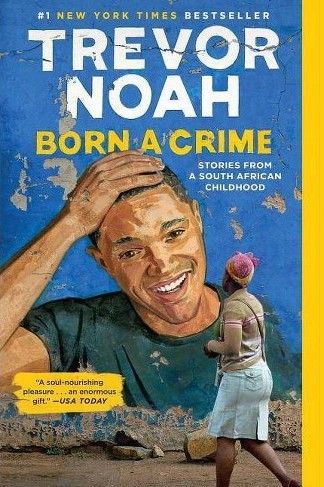
Full disclosure, I have not read this book. I listened to the audiobook.
Trevor Noah’s autobiography, Born a Crime tracks his story growing up in apartheid and post-apartheid South Africa through carefully selected anecdotes. The son of a white Swiss father and black South African mother, his existence was, quite literally, illegal. South Africa’s apartheid laws prevented interracial relationships. Noah recounts stories of having to hide or stay inside in order to prevent getting spotted by police and taken away.
The idea of blending in in order to go unseen runs throughout the book. Noah describes himself as a chameleon. He realizes the importance of communication, and so learns multiple languages in order to seamlessly integrate into different groups. He becomes expert at forming relationships and relating to people, a skill he consciously develops over time. It is not difficult to see how this has contributed to his success as a television host.
Trevor’s mother is also a key character in his story. Her strong faith takes her and her children to three separate church services every Sunday. Noah has memories of these weekly excursions and of the comfort his mother found in her faith. She also passed along the value of self-confidence and the belief that her children could accomplish anything even in the face of the apartheid regime. These would be essential lessons for Noah going forward.
A summary of Born a Crime would not be complete without a mention of Fufi, Noah’s family dog. Both a source of great comfort and comic relief, Fufi is a constant in a life full of change. Noah and his mother move a few times during his childhood and each upheaval is accompanied by a restarting of his efforts to fit in. He faces an impossible paradox. He is too white to be speaking Xhosa with his mother but too black to be speaking English. When he and his mother live in a mostly black neighborhood, he is struck by how alike he looks to his neighbors, but how little he relates to them. This community is mostly Afrikaans-speaking and Noah does not share their Dutch-African ancestry nor their culture. Fufi remains a constant and great comfort to Noah throughout many of these changes.
Noah also, like many members of the Running Group, is an entrepreneur. His first venture is reselling cafeteria food to other students since he is always given first place in line. He briefly moves on to shoplifting, but a brush with the law pushes him on. Next, he sells pirated CDs and builds quite a successful business, a self-described “empire”. He then expands to include dancers and middlemen who perform at different parties around town to Noah’s friend Trevor’s DJing. Experiences with this business lead to powerful insights about the cycle of poverty and the difference between the media portrayal of criminals and the realities of their lives and circumstances.
What I Liked
- Noah’s reading of his own story is a great listen
- The stories are packed with wonderful takeaways about identity, family, and hustle
- He may be considered a comedian, but Noah is also a remarkable serial entrepreneur
What I Didn’t
- While Noah embodies many features of RunningBySix culture, this is not a traditional business or management book. It does not claim to be. While I really enjoyed the story and format, I thought it would be important to provide this caveat.
Overall
Full of heartwarming stories of family and friendship and heartbreaking recollections of apartheid and post-apartheid South Africa, Trevor Noah’s Born a Crime will inspire outbursts of laughter and meaningful discussions. It is no wonder that he has thrived as the host of The Daily Show. His focus on people and scrappy entrepreneurial spirit make him a clear member of the Running Group.
Score: 9/10

 Alexa Murray
Leave a comment